


You were not created to please the world. You were created to please God — and that changes everything.
“Thou art worthy, O Lord, to receive glory and honour and power: for thou hast created all things, and for thy pleasure they are and were created.” — Revelation 4:11, KJV
✦ ✦ ✦
There is a moment many women know well — standing in the middle of a full life that somehow feels entirely empty. The calendar is packed. The roles are being played. The to-do lists are checked. And yet, beneath the noise of productivity and performance, a quiet ache asks: Is this it? Is this all I am?
That ache is not weakness. It is not ingratitude. It is a divine signal — the unmistakable pull of a soul created for more than compartments. It is the voice of a woman who has been living for pleasure — striving to satisfy everyone around her — when she was actually made as God’s pleasure.
Flipping the pleasure principle means releasing the exhausting pursuit of proving your worth through performance, and stepping into the aligned, integrated life God designed you for from the very beginning.
✦ ✦ ✦
The Pain of the Compartmentalized Life
For many women, compartmentalization doesn’t look the way they’d expect — so they never recognize it for what it is. And when you can’t name what’s happening inside you, lasting change feels impossible to find.
The Fragmented Identity
You are one woman at church, another at work, another at home — and none of them feel fully real or fully free. You perform wholeness while feeling fractured inside.
The Exhaustion of People-Pleasing
You pour from an empty cup, terrified that saying ‘no’ means you are not enough. Every boundary feels like a betrayal. Every moment of rest feels like failure.
The Quiet Loss of Purpose
The days blur together. You are busy but not fruitful. Active but not truly alive. You cannot remember the last time you did something that felt like you.
The Spiritual Disconnect
Faith feels like a Sunday compartment, not the oxygen of your daily life. You know the right answers but cannot feel the right presence.
The Passion That Went Silent
Somewhere between responsibility and routine, the dream God placed in you got quietly buried. You stopped believing it was still relevant — or that you were still worthy of it.
These are not personality flaws. They are the symptoms of a life built on the wrong pleasure principle — one that puts your approval at the center instead of His glory.
✦ ✦ ✦
You Were Made as His Masterpiece
The elders in Revelation 4 cast their crowns before the throne — the very symbols of their accomplishment — and declared that God alone is worthy. Not because He earned their praise, but because creation itself exists as an expression of His pleasure.
“Thou art worthy, O Lord, to receive glory and honour and power: for thou hast created all things, and for thy pleasure they are and were created.” — Revelation 4:11, KJV
The word translated ‘pleasure’ here is the Greek thelema — His will, His delight, His intentional desire. You are not an accident. You are not a project God is hoping to finish. You are the ongoing expression of His delight. This is not merely theology — it is the foundation of a life that finally makes sense.
The Psalmist David understood this intimately. In his most vulnerable moments — running from enemies, confessing sin, mourning loss — he kept returning to one anchor: God made me and God knows me.
“I will praise thee; for I am fearfully and wonderfully made: marvellous are thy works; and that my soul knoweth right well.” — Psalm 139:14, KJV
To know that your soul is ‘right well’ made is to stand on ground that cannot shift. When you build your identity there — in the pleasure of your Creator — compartmentalization loses its grip.
✦ ✦ ✦
Faith: The Thread That Ties Every Room Together
Compartmentalization thrives when faith is treated as one department of life rather than the atmosphere of all of it. We clock in on Sunday and clock out by Monday morning. We pray in crisis and hustle in calm. And then we wonder why the pieces never quite connect.
“Trust in the LORD with all thine heart; and lean not unto thine own understanding. In all thy ways acknowledge him, and he shall direct thy paths.” — Proverbs 3:5-6, KJV
All thy ways. Not just your prayer life. Not just your church attendance. Your business. Your marriage. Your creativity. Your rest. Your relationships. Every room of your life has a door — and faith is the key that opens them all to the same light.
Consider Mary of Bethany, who sat at the feet of Jesus while others busied themselves with performance. When Martha complained, Jesus said something that must have stunned the room:
“Martha, Martha, thou art careful and troubled about many things: But one thing is needful: and Mary hath chosen that good part, which shall not be taken away from her.” — Luke 10:41-42, KJV
Mary was not lazy. She was integrated. She had centered herself in the presence of God first, and from that center, everything else would flow. Faith is not a compartment. It is the center — the gravity that holds all the other spheres of your life in orbit. When faith becomes your atmosphere rather than your appointment, you stop fragmenting and start flourishing.
✦ ✦ ✦
Purpose: The Shape of Your Calling
One of the deepest pain points for women living compartmentalized lives is the soul-deep sense that the life they are living does not match the woman they were made to be.
Esther knew this tension. She was a Jewish woman hidden behind a Persian queen’s title, living a double life by necessity, until Mordecai issued a challenge that shook her very identity:
“And who knoweth whether thou art come to the kingdom for such a time as this?” — Esther 4:14, KJV
When Esther aligned who she truly was with where God had placed her — the compartments collapsed and the calling came fully alive. Your purpose is not a side project. It is woven into the very pleasure of God in creating you.
“For we are his workmanship, created in Christ Jesus unto good works, which God hath before ordained that we should walk in them.” — Ephesians 2:10, KJV
The word ‘workmanship’ is the Greek poiema — the root of our English word poem. You are God’s poem. A carefully crafted, intentional work of art written to carry meaning into the world. When your daily life aligns with that poem, purpose stops feeling like a distant dream and becomes the road you are already walking.
✦ ✦ ✦
Passion: The Holy Fire You Were Told to Quiet
Somewhere along the way, many women received the message that passion was dangerous. Too much. Too loud. So they quieted the dream, dimmed the fire, and settled into dutiful smallness — all while wondering why the joy never came back.
But passion, surrendered to God, is not dangerous. It is divine.
Deborah was a woman of extraordinary passion. In a time when women were expected to remain invisible, she sat as judge and prophetess over all of Israel — and when the moment required it, she rose to lead an army.
“I will sing unto the LORD, I will sing praise to the LORD God of Israel… So let all thine enemies perish, O LORD: but let them that love him be as the sun when he goeth forth in his might.” — Judges 5:3, 31, KJV
Deborah did not apologize for her fire. She aimed it at God’s glory. Passion surrendered to purpose rather than driven by ego becomes a consuming flame for the Kingdom.
“I can do all things through Christ which strengtheneth me.” — Philippians 4:13, KJV
Passion aligned with purpose, rooted in faith, does not burn you out. It burns for you — illuminating the path God has already prepared and lighting the way for the women watching you walk it.
✦ ✦ ✦
The Integrated Life: Honoring God With the Whole Woman
An integrated life is not a perfect life. It is an aligned life — one where what you believe, how you live, what you pursue, and who you are in private are no longer strangers to each other.
“He hath shewed thee, O man, what is good; and what doth the LORD require of thee, but to do justly, and to love mercy, and to walk humbly with thy God?” — Micah 6:8, KJV
Justice. Mercy. Humility. These are not compartments. They are qualities of a whole character — lived out simultaneously in the boardroom and the kitchen, in the quiet hour of prayer and the loud season of influence.
To honor God with an integrated life means your faith speaks first — before your fear, before others’ opinions. Your purpose governs your yes — you stop saying yes to everything because you finally know what you were made for. And your passion is unleashed, not apologized for — because you understand it was placed in you by the same God who called all of creation very good.
“And whatsoever ye do, do it heartily, as to the Lord, and not unto men.” — Colossians 3:23, KJV
Heartily. From the soul. Fully. Not the performance of a fragmented self — but the wholehearted offering of a woman who has found her center and will not leave it.
✦ ✦ ✦
Flip the Principle. Live the Life.
The world will always have another role for you to play, another box to check, another expectation to meet. But God is not waiting for your performance. He is waiting for your presence — the full, unedited, integrated presence of the woman He made for His pleasure.
The elders in Revelation did not cling to their crowns. They cast them down. And in that act of surrender, they discovered the only identity that truly satisfies: Beloved of God. Made for His glory. Living for His pleasure.
Stop splitting yourself into rooms. Open every door. Let His light fill all of it.
“Whether therefore ye eat, or drink, or whatsoever ye do, do all to the glory of God.” — 1 Corinthians 10:31, KJV
✦ ✦ ✦
Blessings to you!
MC
(C)2026 Mikaela Cade Coaching and Consulting
“Your talents are not accidents; they are appointments. Use them intentionally, serve them faithfully, share them generously.”
Have you ever dismissed your natural abilities as “no big deal” because they come easily to you? Have you overlooked your talents because they don’t seem as impressive as someone else’s?
Here’s a truth that might change your perspective: the things you’re naturally good at are not random cosmic accidents. They are divine appointments.
God didn’t accidentally wire you with the ability to teach, or solve complex problems, or create beauty, or organize chaos, or connect with people. These aren’t arbitrary traits. They’re purpose-oriented design features.
Think of it this way: if you were creating a tool for a specific job, you’d design it with the features necessary to accomplish that task. A hammer needs weight and a striking surface. A saw needs sharp teeth. A screwdriver needs a fitting tip.
You were designed with the talents you have because they’re necessary for the work you’re meant to do. Your talents are clues to your calling.
But here’s where many people get stuck: they have the talents but don’t steward them well.
Use them intentionally – Don’t wait for the “perfect” opportunity to use your gifts. Use them today, where you are, in small ways. Intentionality compounds over time.
Serve them faithfully – Develop your talents. If you’re good at something, get great at it. Excellence honors the Giver of the gift.
Share them generously – Don’t hoard your abilities. The point of having talents isn’t personal accumulation; it’s collective contribution. Who needs what you have?
The world doesn’t need you to discover talents you don’t have. It needs you to fully steward the ones you do.
Scripture for Reflection:
“Each of you should use whatever gift you have received to serve others, as faithful stewards of God’s grace in its various forms.” – 1 Peter 4:10
“Having gifts that differ according to the grace given to us, let us use them.” – Romans 12:6
Your Next Steps:
List three talents or abilities that come naturally to you. Don’t dismiss them as “everyone can do this”—if it’s easy for you, it’s probably your talent. Now answer: How are you currently using each one? How could you use them more intentionally this week?
Blessings to you!
MC
Purpose isn’t found in perfection—it’s discovered in persistence. Every faithful step forward is progress toward your calling.
We live in a social media post-filtered world where everyone’s purpose journey looks polished, linear, and divinely orchestrated. One day they’re confused, the next day they have perfect clarity, and by day three they’re living their dream life.
Yet most of us experience something quite different. That’s not how purpose discovery actually works.
Purpose is discovered through persistent faithfulness, not perfect clarity. It’s found in showing up day after day, even when the path isn’t clear. It’s cultivated through thousands of small decisions that, over time, create a trajectory toward your calling.
Each faithful step forward brings us into greater alignment with who we’re meant to be. Think of it like driving at night with your headlights on. You can only see about 200 feet ahead, but you can make the entire journey that way. You have confidence that you will reach your destination even though you can’t see the whole route. You don’t need to see the destination to take the next step. You just need enough light for the road immediately in front of you.
I’ve watched people paralyze themselves waiting for perfect clarity before taking action. They want to know every potential obstacle they’ll face along the way. They want to see the summit before they begin climbing the mountain.
But here’s the truth: clarity often comes through action, not before it.
Faith requires moving forward with confidence in your end goal, even when you can’t see every step of the journey. When we persist through uncertainty, we discover that alignment isn’t a destination—it’s a daily practice of faithful action toward our calling.
Every conversation you have, every project you complete, every risk you take, every failure you learn from—these are all data points helping you understand your purpose more clearly. The person who takes imperfect action will discover their purpose faster than the person who waits for perfect certainty.
Persistence looks like:
- Showing up even when you don’t feel like it
- Learning from failures instead of being defined by them
- Taking the next right step even without seeing the whole staircase
- Trusting that God is working even when you can’t see it
Scripture for Reflection: “Let us not become weary in doing good, for at the proper time we will reap a harvest if we do not give up.” – Galatians 6:9
“Being confident of this, that he who began a good work in you will carry it on to completion until the day of Christ Jesus.” – Philippians 1:6
Your Next Step: If you’re tired of waiting for perfect clarity and ready to start discovering your purpose through persistent action, the 5-Day Purpose Challenge is designed exactly for you. Five days of practical exercises that help you move from confusion to clarity through strategic action. Join the next challenge here and start your journey to extraordinary.
Blessings to you!
MC
There’s a diagnostic question that reveals more about your career alignment than any personality test or skills assessment: How do you feel on Sunday night?
If you dread Monday morning, if Sunday evening brings anxiety about the week ahead, if you’re constantly counting down to Friday—these are symptoms of misalignment. Not necessarily symptoms of a bad or wrong job, but symptoms of work that isn’t connected to your deeper purpose.
Now, let me be clear: even purpose-aligned work has challenging days. Even when you love what you do, there will be difficult projects, demanding clients, and seasons of stress. Purpose doesn’t eliminate challenges; it transforms how you experience them.
When you’ve found the sweet spot where passion, purpose, and provision align, something shifts. Monday morning stops feeling like a five-day sentence to serve before weekend parole. It becomes an opportunity to do work that matters, with people you value, toward outcomes you believe in.
The sweet spot has three essential elements:
- Passion – You’re engaged by the work itself. It energizes rather than drains you. You’d do some version of this work even if you weren’t getting paid.
- Purpose – Your work connects to something bigger than yourself. You can articulate how it contributes to the greater good, serves others, or advances causes you care about.
- Provision – You’re compensated fairly for your contribution. You’re not martyring yourself financially in the name of “following your passion.” Sustainable purpose requires sustainable provision.
When these three align, work doesn’t feel like work in the soul-crushing sense. It feels like contribution. Like ministry. Like you’re operating in your design.
Scripture for Reflection:
“Delight thyself also in the Lord: and he shall give thee the desires of thine heart. Commit thy way unto the Lord; trust also in him; and he shall bring it to pass.” – Psalm 37:4-5 (KJV)
“For I know the thoughts that I think toward you, saith the Lord, thoughts of peace, and not of evil, to give you an expected end.” – Jeremiah 29:11 (KJV)
There’s a sacred moment that happens when you stop seeing your work as mere employment and start experiencing it as service. It’s the shift from “I have to go to work” to “I get to serve through my work.”
Think about it: every email you send, every meeting you lead, every problem you solve, every interaction you have—these aren’t just professional transactions. They’re opportunities to serve people God has placed in your path.
The barista making coffee isn’t just preparing beverages; she’s creating moments of comfort and connection for hurried commuters starting their day. The software developer isn’t just writing code; he’s building solutions that make people’s lives easier. The accountant isn’t just managing numbers; she’s providing peace of mind and financial stewardship.
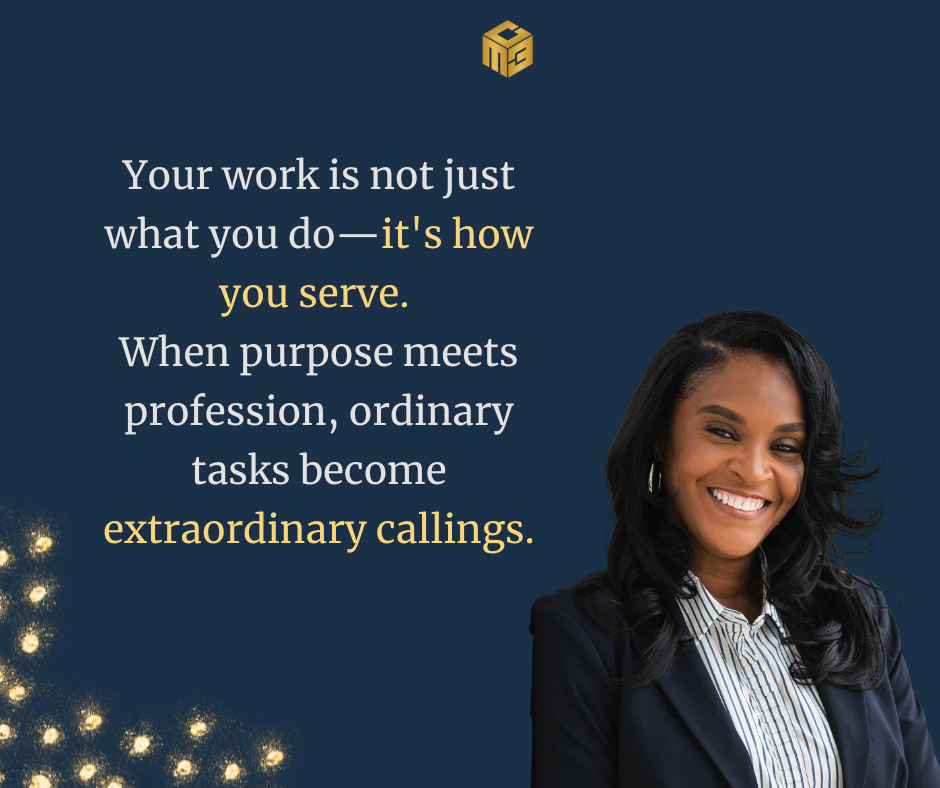
When purpose meets profession, transformation happens. The mundane becomes meaningful. The routine becomes sacred. The ordinary becomes extraordinary.
This doesn’t mean every task will feel inspiring. You’ll still have difficult days, challenging projects, and responsibilities you’d rather delegate. But when you understand that your work—whatever it is—can be an expression of service to God and others, even the difficult tasks take on new significance.
“Whatever you do, work at it with all your heart, as working for the Lord, not for human masters.” – Colossians 3:23
Think About It:
What would change if you approached your work this week as service rather than obligation? Share your thoughts in the comments below. How has your perspective on work shifted as you’ve grown in your faith?
“The earth is the Lord’s, and the fullness thereof” calls us to a profound recognition: there exists no higher power, no greater authority, no clearer truth than our Creator.
As the One who brought all things into being, God holds ultimate authority over all creation. We should always, always recognize and respect that truth.
This reality of this truth invites us to take our rightful place on earth—not as owners, but as humble stewards.
We are called to approach our Creator with hearts eager to know Him. It ensures our mind and will are committed to serving His purposes. The truth helps us understand that every resource we handle, every opportunity we encounter, every breath we take is graciously entrusted to us for this earthly journey.
When we truly grasp this perspective, it transforms everything.
Our faith ceases to be compartmentalized into Sunday mornings or quiet devotions.
Instead, it becomes the lens through which we view our work, relationships, finances, and daily decisions. We begin to see ourselves as stewards of God’s gifts rather than masters of our own destiny. It leads to love and the fruit that grows from it. But understand me here, this kind of love is not weak or passive or without standards, but filled with compassion, right thinking, right speaking, and right actions that lead to healing and realized purpose.
Let this simple yet profound truth reshape how you live today and beyond. In recognizing God’s sovereignty over all creation, may you find both your proper humility and your divine purpose as faithful stewards of His abundant provision.
Blessings, MC
Why your boardroom, startup, or career might be exactly where God needs you most
Continue ReadingThe psalmist wasn’t questioning intelligence—he was exposing something deeper: how the heart’s quiet rebellion against divine authority slowly erodes our capacity for love, compassion, and justice.
Most people wouldn’t openly declare “God doesn’t exist.” But when our hearts whisper “His authority doesn’t apply here,” we’ve already started down a dangerous path.
Here’s the pattern:
- It starts internally (the heart’s declaration)
- It spreads outwardly (affecting our actions)
- It ends destructively (corrupt works and broken relationships)
This isn’t about denying God’s existence—it’s about rejecting His authority in our daily choices. When we decide we’re the ultimate authority in our lives, we inevitably create our own version of reality and moral code.
The result? We feel justified taking matters into our own hands, even when it means betraying truth and hurting others.
Where in your life might your heart be quietly saying “I’ve got this” instead of “God’s got this”?
No shade here—we all struggle with this. It’s an invitation to pause and examine the moments when we feel most entitled to control outcomes, bypass accountability, or create our own rules.
What’s one area where you’ve been tempted to “take matters into your own hands” lately? 👇
#MikaelaCade #BeExtraordinary #Faith #SelfReflection #Wisdom #Authority #HeartCheck
©2025 Mikaela Cade Coaching and Consulting/Mikaela Cade Ministries